The World Cup’s Smallest Venue Is Toronto’s Biggest Bet
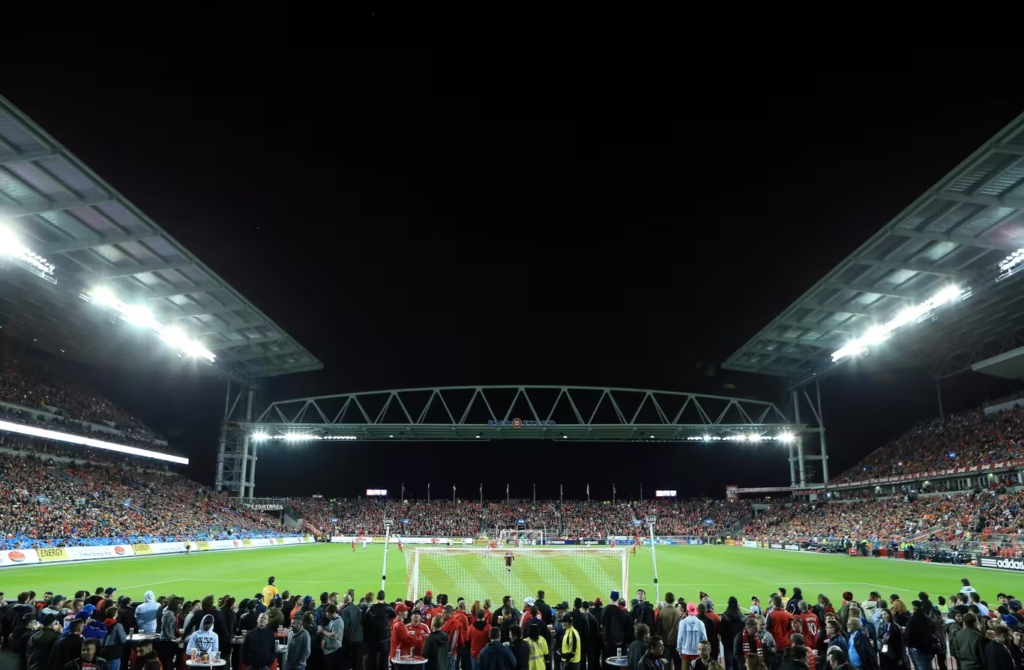
The video boards went up first. Five million pixels apiece. Four massive screens now tower over the corners of BMO Field, the glaring new sign of a $146 million change turning this 18 year old soccer ground into “Toronto Stadium” for the 2026 World Cup.
Come June, their job will be to show 45,000 fans every detail of Canada’s first men’s World Cup match on home soil. But their presence points to a bigger gamble. This is FIFA’s wager on feeling over sheer size.
At 45,000 seats, Toronto will be the smallest stage in the North American tournament. SoFi in Los Angeles fits over 70,000. MetLife in New Jersey holds more than 82,000. But this place on the lakeshore offers what most of those football palaces cannot. It was built for this sport alone.
That fact is the heart of the story. BMO Field is the modern outsider. Among the eleven United States and Canadian host venues, it stands alone as the only one originally designed as a permanent home for a Major League Soccer club. Every other stadium, from Atlanta to Vancouver, was built first for the NFL or as a multipurpose dome.
Mexico’s legendary Estadio Azteca remains the tournament’s other true soccer shrine, but BMO Field is its philosophical opposite. Where Azteca is a monumental bowl built for spectacle, BMO Field is an intimate, steep sided cauldron. One is about awe. The other is about pressure. Now, that pressure is being quantified in steel and concrete.
The work is on a tight clock. FIFA officially takes control on May 12, 2026, leaving just a month for the final touches. To hit the 45,000 seat floor, 17,756 temporary seats are being grafted onto the north and south ends. The field itself is being converted to a SIS Grass hybrid system, where synthetic fibers are stitched 20 centimeters deep into the natural turf to withstand the six match sprint.
Inside, the makeover is just as intense. A new 80 person Center Field Lounge has been created by merging four existing executive suites to host heads of state. Even the concessions are changing, with computer vision technology installed at select stands to slash halftime waits to under 60 seconds.
For the fans who have lived through every high and low here, the validation is the real prize. The World Cup is a six week visitor, but the better stadium remains. When the temporary seats come down, the north end will keep a permanent, 1,000 seat rooftop patio, a nod to the city’s lakefront lifestyle that ensures the venue outlasts the global circus.
On June 12, 2026, Canada will walk out in Toronto. In a city where 51 percent of residents were born outside the country, the crowd will be a mosaic of the globe. But the sound in that tight, steep bowl will be pure, focused energy.
In a tournament that will fill American football cathedrals, this Canadian soccer ground offers something different. You will see the players’ expressions from almost any seat. You will feel the game in the stands.
Sometimes, for a sport of passion and proximity, the smaller stage is not a compromise. It is the whole point.